


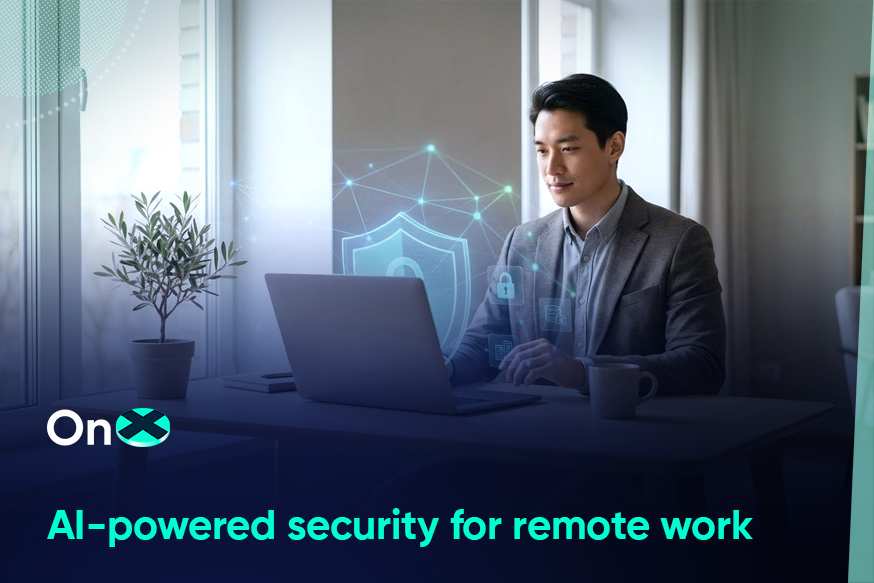
The ongoing shift to remote and hybrid work has introduced more flexibility for employees. But it has also introduced more vulnerabilities for company networks. With off-premises employees, data may be at greater risk than when they’re on an office network. To mitigate these risks, companies will need to upgrade their cybersecurity strategy.
That’s where AI in cybersecurity can help address these new risks. AI, in particular Machine Learning (ML), can facilitate a more nimble, efficient way for organizations to take their cybersecurity to the next level. There’s too much at stake not to act now.
Learn more: Navigating a new frontier of cybersecurity: Generative AI risks
Without AI in cybersecurity, or doubling your security operations team, remote work puts data at risk
Remote work gives workers the flexibility they’re seeking. But there are three major security risks to these arrangements:
- Unsecured home networks that introduce unknown risks.
- Personal devices, like cell phones, tablets, or laptops, that lack enterprise-grade endpoint protection and full disk encryption.
- Unknown loud services that lack sufficient safeguards.
These three risks leave networks vulnerable to attacks in ways that legacy firewalls and network security tools simply cannot defend against. What’s more, it’s becoming increasingly difficult for legacy systems to distinguish between authorized and unauthorized users. A company may work with external contractors whose identities can be more easily compromised. Continuously establishing and verifying a user’s identity is crucial for mitigating the security risks associated with remote work. AI in cybersecurity can be the perfect tool for the job.
Additionally, without the right strategy, companies risk exposing confidential and proprietary data, compromising user credentials, facing legal issues, and incurring reputational damage. Security breaches can also be expensive. According to Thomson Reuters, the average cost of a data breach, exposing sensitive user data, is nearly $5 million. An IBM report detailed how costs go up when remote work is involved. Why? Largely because companies take longer to identify breaches that occur outside the office network.
Using AI in cybersecurity can:
- Lower personnel costs.
- Give IT teams time back for higher-value work.
- Ensure remote workers have the necessary access while keeping their data secure.
A powerful tool for ensuring remote work is safe
AI in cybersecurity can detect and respond to breaches and other security threats faster, often in real time, whether workers are in the office or not. That’s because it can analyze massive amounts of data—pulled from across apps, networks, and devices—to spot patterns that indicate problems and engage automated defenses.
Continuous monitoring of your networks and endpoints for threats is one of AI’s most powerful benefits. It can determine whether an individual’s permissions align with their job role, automatically create new e-mail filters to block phishing attempts, and correctly classify data before it’s sent over an unsecured network. AI in cybersecurity is the most effective way to outmatch the continuously evolving tactics of malicious actors.
Learn more: The need for enterprise hybrid cloud security is increasing with the rise of AI
Managed services companies help you navigate the journey
As the kinds and amounts of cybersecurity threats grow, companies must upgrade their monitoring and security solutions. That’s a complex effort that requires the right team and infrastructure. Managed services companies have the experience, staff, and relationships with technology partners you need to implement the right AI in cybersecurity solutions.
OnX can help you navigate the journey toward upgrading your cybersecurity posture, including security assessments, strategic design, solution implementation, and managed security services.
Get in touch with OnX today to get started.