





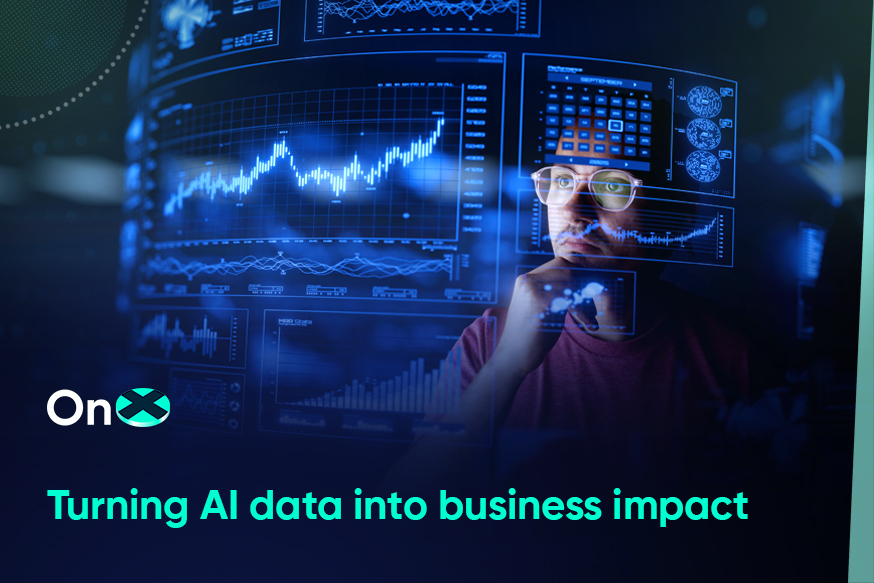
The more businesses deploy AI, the more data it generates. That data contains insights that might help organizations make better strategic decisions. But to derive those insights, they’ll need next-level data analytics.
AI itself can provide businesses with the solid analytics foundation they need to make sense of all that data. In short, AI for data analytics can help an organization leverage its AI-generated data to drive growth and efficiency.
AI produces more data to analyze
With every customer service interaction, every business process automation, every new prediction comes a new data point. Eventually, businesses face a massive amount of data that must be stored, organized, and analyzed to deliver the greatest value. For example, retailers can track a customer’s response to a personalized product recommendation and assess whether the customer made a purchase as a result. But without AI for data analytics, they’re leaving opportunities to improve click-through and purchases on the table.
AI is also valuable for improving the performance of your enterprise AI over time. It can:
- Evaluate AI outputs to ensure they’re factual, fair, and effective.
- Identify any issues such as model drift or bias.
- Refresh an organization’s AI strategy.
- Provide actionable insights.
Learn more: AI-driven data analytics gives retailers enhanced customer insights
Why invest in AI to derive insights from AI-produced data
Humans can extract remarkable value from the information AI produces. However, the real impact occurs when people and AI collaborate. This combination creates what many call augmented intelligence: a dynamic partnership where technology amplifies human judgment rather than replacing it. With it, teams can act more quickly and accurately.
We’re already seeing this collaboration reshape industries. In healthcare, providers can utilize AI-driven insights to identify early signs of health issues. In logistics, AI data analysis enables organizations to adjust routes and prevent disruptions. In financial services, predictive modeling supports smarter risk management and identifies new market potential.
But building a strong data analytics foundation requires the right capabilities:
- Systems that unify data across tools, teams, and environments.
- Platforms that surface patterns and trends at scale.
- Instant, actionable insights to support rapid decision-making.
- Metrics and benchmarks that track performance and guide improvement.
When companies use AI for data analytics, they gain more than efficiency—they gain a sharper, more strategic form of intelligence.
Read more: OnX introduces data analytics services to accelerate enterprise AI readiness
Using AI to gain strategic insights
AI can derive insights from the data it generates far more efficiently than traditional tools. It doesn’t just process information faster—it can round up, categorize, and clean messy datasets, such as merging duplicate customer IDs or standardizing inconsistent entries. It also excels at interpreting unstructured data, such as images, audio files, e-mails, and texts, transforming them into usable intelligence.
However, the value extends far beyond data cleanup. Modern AI for data analytics can:
- Provide real-time guidance to customer service representatives by surfacing relevant past interactions and suggesting the following best action.
- Power intelligent dashboards that help teams track the risk of churn, customer satisfaction trends, or operational bottlenecks as they emerge.
- Spot correlations or anomalies between data points that legacy analytics tools often overlook.
- Forecast sales trends for new products based on historical data, market performance predictions, and customer behavior.
- Enable employees to use natural language prompts to analyze customer messages, reviews, or survey responses and generate instant summaries or insights.
- Automatically categorize support tickets or service requests to streamline routing and prioritize urgent issues.
- Detect quality issues in manufacturing through image recognition or sensor data, helping teams intervene before defects reach customers.
These are just a few examples of how AI is transforming how organizations interpret and use their data. At its core, the technology is designed to empower humans by providing clearer visibility, faster answers, and a stronger foundation for informed decision-making.
Partner with us to successfully implement AI for data analytics
Businesses may already have robust enterprise AI to perform critical but repetitive tasks, help customers, and more. However, without a strategy to maximize the value of all the data AI generates, they miss the opportunity to transform it into actionable insights. That might be because they lack the time or in-house skills. Enter a certified AI partner like OnX, which has the expertise and experience to help you quickly and confidently design and implement AI for data analytics. The right partner is crucial to helping you stay ahead of the curve as more businesses adopt AI.
Let OnX help you navigate a path toward leveraging AI for data analytics to drive business success. Contact OnX today to learn more.